
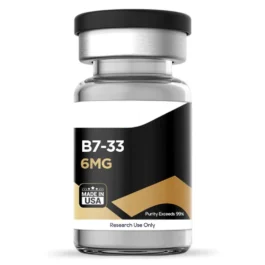
Buy B7-33 Peptide Online – Advanced Relaxin Analog for Research
Overview
B7-33 is a synthetic peptide engineered as a smaller, more stable analog of the naturally occurring hormone relaxin (H2-relaxin). Designed to replicate key biological actions while improving solubility and control in research settings, B7-33 has become a growing focus in studies related to tissue remodeling, vascular health, and fibrosis.
Unlike traditional relaxin pathways, B7-33 is believed to signal primarily through the pERK pathway, offering a different cellular response profile compared to the classic cAMP route. This distinction has drawn attention in experimental models where targeted signaling and reduced off-target effects are being explored.
Chemical Profile
- Molecular Formula: C₁₃₁H₂₂₈N₄₀O₃₇S
- Molecular Weight: 2987.75 g/mol
- Other Names: (B7-33)H2, GTPL9321
Mechanism of Action
B7-33 is thought to bind with high affinity to RXFP-1 receptors, a key receptor associated with relaxin activity. Once activated, it may initiate intracellular signaling via the pERK pathway, which is linked to cell survival, repair, and remodeling processes.
This signaling may promote the production of enzymes such as MMP-2, which are involved in breaking down excess extracellular matrix proteins. By influencing these pathways, B7-33 is being studied for its potential role in limiting abnormal tissue buildup.
Key Research Insights of B7-33 Peptide for Sale
Anti-Fibrotic Potential
One of the most researched aspects of B7-33 is its potential role in reducing fibrosis. Experimental studies suggest it may help limit excessive connective tissue formation, a process associated with reduced organ function in various models.
In preclinical settings, B7-33 has been linked to:
- Reduced cardiac tissue fibrosis
- Improved tissue remodeling dynamics
- Targeted signaling without activating pathways linked to unwanted cell growth
Vascular Function & Protection
Research indicates that B7-33 may support vascular function by enhancing relaxation responses in blood vessels. Studies in experimental models suggest improved endothelial activity, particularly in specific vascular regions.
This has positioned B7-33 Peptide for Sale here as a compound of interest in:
- Blood vessel function studies
- Endothelial health research
- Circulatory system modeling
Cellular Growth & Repair Signaling
Through its interaction with RXFP-1 receptors, B7-33 may influence pathways involved in:
- Cell growth and survival
- Tissue repair mechanisms
- Gene expression related to structural proteins
Its selective signaling profile makes it especially relevant in studies focused on controlled cellular responses.
Emerging Research Areas
Additional experimental work has explored B7-33 Peptide for Sale here in:
- Growth factor signaling (including VEGF-related pathways)
- Tissue regeneration models
- Device coating applications to reduce fibrotic buildup
Why Researchers Choose B7-33 Peptide for Sale here
- Next-generation relaxin analog with improved stability
- Targets pERK signaling instead of traditional pathways
- Strong receptor affinity (RXFP-1)
- Expanding research applications in fibrosis and vascular studies
Final Note
B7-33 represents a refined approach to relaxin-based research, offering a more targeted and controlled way to explore tissue remodeling and cellular signaling pathways in advanced laboratory settings.
Related products
Hormonal & Signaling Peptides
Hormonal & Signaling Peptides
Hormonal & Signaling Peptides
Hormonal & Signaling Peptides
Hormonal & Signaling Peptides
Hormonal & Signaling Peptides
Hormonal & Signaling Peptides
Hormonal & Signaling Peptides