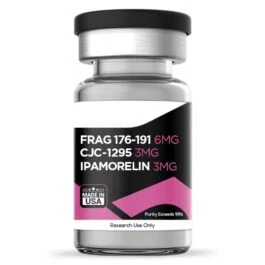
Fragment 176-191 & CJC-1295 & Ipamorelin Blend (12mg)
$69.35
Size: 12mg
Contents: Fragment 176-191 (6mg), CJC-1295 NO DAC (3mg), Ipamorelin (3mg)
Form: Lyophilized powder
Purity: >99%
SKU: P-FRAGCJCIPAM-12
FREE Shipping on $200+ orders
A research-focused peptide blend combining CJC-1295, Ipamorelin, and Fragment 176-191. Designed for studies involving growth hormone signaling, fat metabolism, and body composition models.
Ipamorelin & Fragment 176-191 peptide & Buy CJC-1295
Overview
This research peptide blend combines Fragment 176-191, Buy CJC-1295, and Ipamorelin, three compounds commonly studied for their interaction with growth hormone pathways and metabolic signaling. Each component targets a different biological mechanism, making this stack of interest in laboratory models exploring hormonal regulation, body composition, and recovery-related processes.
Rather than relying on a single pathway, this blend brings together GHRH receptor activation, ghrelin receptor signaling, and direct lipolytic peptide activity, allowing researchers to observe how multiple growth-related systems may interact under controlled conditions.
How the Blend Works (Research Context)
CJC-1295 (GHRH Analog)
CJC-1295 is a synthetic analog of Growth Hormone-Releasing Hormone (GHRH). It is studied for its ability to bind GHRH receptors in the pituitary gland, which may stimulate sustained growth hormone release. Its modified structure is designed to extend activity duration in experimental settings.
Ipamorelin (GHRP / Ghrelin Mimetic)
Ipamorelin & Fragment 176-191 peptide is classified as a growth hormone secretagogue that interacts with ghrelin-sensitive receptors (GHS-R1a). Research suggests it may stimulate pulsatile growth hormone release while maintaining selectivity compared to earlier GHRPs, making it useful in studies focused on hormonal pulsatility and signaling balance.
Fragment 176-191 (Lipolytic GH Fragment)
This peptide is a shortened fragment of human growth hormone and is widely studied for its fat metabolism-related signaling, particularly through beta-3 adrenergic receptor pathways. It is of interest in research exploring adipose tissue behavior and thermogenic activity.
Combined Research Potential
When studied together, these peptides are often explored for their multi-pathway hormonal interaction profile, including:
- Growth hormone secretion signaling (pituitary activation)
- Fat metabolism and lipolysis pathways
- Lean tissue and body composition modeling
- Recovery and tissue regeneration pathways in experimental systems
- Endocrine system feedback regulation
This combination is frequently used in research exploring how dual and triple pathway stimulation may influence endocrine output and metabolic response balance.
Research Observations
Scientific literature on the individual components suggests potential findings such as:
- Increased growth hormone release in pituitary cell models (CJC-1295, Ipamorelin & Fragment 176-191 peptide)
- Enhanced GH pulse amplitude and frequency in experimental settings
- Fat oxidation signaling activity associated with Fragment 176-191
- Shifts in lean-to-fat ratio in animal model observations
- Possible modulation of IGF-1 expression downstream of GH activity
These findings are preliminary and model-dependent, and outcomes vary based on dosage, system type, and experimental conditions.
Why Researchers Use This Blend
This peptide combination is commonly selected in studies aiming to:
- Compare dual vs multi-pathway GH stimulation
- Evaluate metabolic vs anabolic signaling balance
- Observe endocrine feedback mechanisms under combined receptor activation
- Study fat metabolism alongside growth hormone signaling
- Investigate systemic effects of sustained GH elevation
Chemical Composition
- Fragment 176-191: C78H125N23O23S2
- CJC-1295: C152H252N44O42
- Ipamorelin: C38H49N9O5
Important Note before you Buy CJC-1295
This product is intended strictly for laboratory and research use only. It is not approved for human consumption or medical use. All information provided reflects experimental findings and published scientific observations.
Related products
Hormonal & Signaling Peptides
Hormonal & Signaling Peptides
Anti-Aging & Skin Peptides
Muscle Growth & Performance Peptides
Muscle Growth & Performance Peptides
Anti-Aging & Skin Peptides
Muscle Growth & Performance Peptides
Healing & Recovery Peptides